
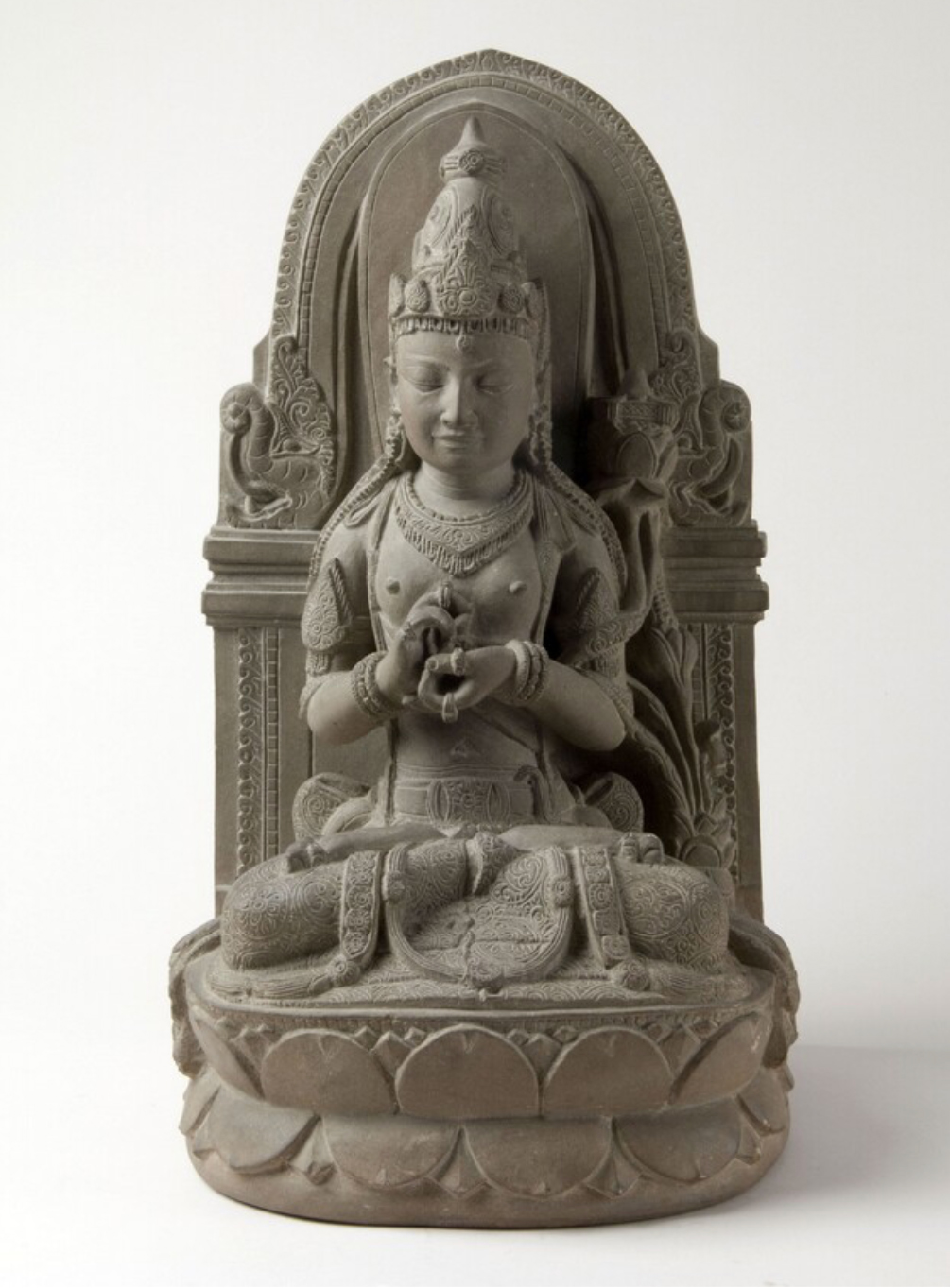
Iko, Prajnaparamita, Andesite, dimensions unknown, Wereldmuseum, Amsterdam, inv.
no. TM-2872-12.
According to M.B. van der Jagt, former governor of Surakarta, Iko carved this statue from andesite for him in 1911 (Jagt, Memoires, 64). Iko is said to have created it from memory. This is likely the statue now in the Wereldmuseum Collection and was acquired from a bequest on January 1, 1960. In the
second private will drawn up by Van der Jagt, it is described as: “The Hindu statue of andesite; depicting Pradjnaparamita, the goddess of “the highest wisdom,” “the mother of patience and self-control,” “carved by Iko, the Sundanese sculptor in Bandung in 1910.” This will also reveals that, after Van der Jagt’s death, the statue was intended for the Indies Institute in Amsterdam, the old Colonial Museum (NA, Collection 421 M.B. van der Jagt. C22143. 2.21.205.56. Inventory no. 35). The statue is not described as such in Van der Jagt’s inventory, drawn up in The Hague on January 23, 1942, by C.A.J. de Weerdt-v.d. Moer. However, mention is made of a “Buddha statue” in gray stone in the lower hallway of the house where Van der Jagt lived. A large photograph of Borobudur is also located in this room. (NA, Collection 421 M.B. van der Jagt. C22143. 2.21.205.56. Inventory no. 35. Inventory of the contents). Since Van der Jagt later described the Prajnaparamita in the written wills in the same paragraph as this photo, it is quite conceivable that this Buddha statue refers to the Prajnaparamita of Iko. After all, andesite is
gray in color. In the subsequent will, the statue of Iko is described as a Hindu Buddha statue (crossed out by Van der Jagt). This could also explain the inclusion of the statue as a Buddha statue in the inventory. See also: Collectie Wereldmuseum, “Andesiet stenen beeld van Pradjnaparamita gehouwen door Iko de bekende Christen Sundanese beeldhouwer.” The latter remark is actually wrong. Iko never converted to catholicism.
Leave a Reply